Friday, May 15, 2009

Abstract

The title of this trial is Physiology of Exercise Laboratory and it is in the physiological systems of the human body section. The purpose of this experiment was to verify our predictions about how the body systems would respond to increased physical activity. This
test is the source to understand clearly how each of the systems work together in order to make our body function properly and effectively. The procedures involved testing three levels of exercise by having a volunteer accomplish the activities. Ten minutes of complete rest, of light walking and of a harder jogging were evaluated. The data observed was the pulse, the respiration rate, systolic blood pressure, the diastolic blood pressure and the internal and external temperature. The volunteer which achieved the task was an average size teenager with no health of physical problems. Only a normal teenager was evaluated because an average result was required. The results were examined several times during the exercise to see how the data increased and how much time it took. The more demanding activity had the highest results and all the student's body metabolic mechanisms reacted to the change of action level. The experimentation worked out well because the activities were took seriously and with effort. The data concluded that our body systems do respond to increased physical motion because the the results changed right when the level of exercise attempt was more demanding than the previous actions.
.
.

Wednesday, May 13, 2009

Introduction

"Metabolism is the set of chemical reactions that occur in living organisms in order to maintain life. These processes allow organisms to grow and reproduce, maintain their structures, and respond to their environments. This experiment measures basic body metabolic parameters:

* pulse *

* respiration rate *

* blood pressure *

* temperature and sweat *


The objective of this lab is to measure body metabolic mechanisms in response to different levels of exercise: pulse, respiration rate, blood pressure, temperature (internal and external) and sweat.
.
.

Tuesday, May 12, 2009

Procedures


The three different conditions of activity consisted:

* Having a student volunteer laying down at complete rest for ten minutes.

* Having a student volunteer to do a light activity for five minutes.

* Having a student volunteer to do an intense activity for five minutes.

After each activity the metabolic rates were measured as quickly as possible using: oral thermometer, ordinary thermometer, sphygmomanometer (blood pressure gauge), piece of microscope tissue (for sweat), stethoscope.

- The oral thermometer should use cover slips and/or be disinfected with mouth wash before
each use.
.
.

Sunday, May 10, 2009

Materials

* A flat surface *
* A large area to move around in *
*
Arm type automatic digital blood pressure monitor *
* Stethoscope *
* Mouth thermometer *
* Small pieces of thin paper *
* Plastic piece to cover thermometer *
* Other material to help the volunteer relax (blankets, pillow, ear plugs, etc.) *
* Pencil and paper to record results *

-- -- -- -- -- -- -- -- -- -- -- -- --
.
.

Hypothesis


The hypothesis would be that the faster the subject's pulse and respiration returns to normal, the better is the subject's cardiovascular and pulmonary systems.


Another supposition concerning this experiment would be that the subjects inhaling oxygen would return to their normal pulse and respiration rates faster than subjects who were not provided with oxygen.
.
.

Tuesday, May 5, 2009

Results

Here are the pictures of the mean results.


Monday, May 4, 2009

Discussion

The purpose of this experiment was to verify our predictions about how the body systems would respond to increased physical activity. In order to attest our hypothesis, some volunteers participated in three different exercise levels and afterwards got their body metabolic mechanisms measured and evaluated. The data observed after each activity had a similar pattern to which we has already suspected. More the action was demanding, the higher were the results and the more the body reacted. When the students was resting, the data was normal and stayed around average, oppositely with the harder jog or warm-up, where each data had more of a serious result.

These aftereffects occurred because the human system had to interact in order to keep the cells working. Each cell in the muscles needed more oxygen when doing more work because of increased cellular respiration within the cell. During exercise, the liver generates extra glucose while increasing the volume of the blood being pumped by the heart. Respiration by the lungs provides an increased amount of oxygen. When the activity level in very prolonged and demanding, a degeneration of the level of glucose in blood, may happen. There can also be physical damage due to dehydration and ricks of low blood pressure. Prolonged exercise is made possible by the human thermoregulation (keep its body temperature within certain boundaries) capacity to remove waste by sweat evaporation.
Humans have a large ability to expend energy for many hours doing maintained exercise. Skeletal muscled burns, every minute in continuous activity, glucose and energy. The amount varies somewhat with size, gender and age. Exercise sustained for very long periods of time, dominate the energy metabolism of the body.

Blood is a mixture of cells and a watery liquid, called plasma, that the cells float in. It also contains other things like nutrients (such as sugar), hormones, clotting agents, and waste products to be flushed out of the body. It is made up of red blood cells, white blood cells and platelets. Blood is the transport system for oxygen, glucose, carbon dioxide and part of the water. Oxygen in the blood is carried by a system of tubules made-up of arteries, arterioles, and capillaries. Oxygen diffuses from the high concentration in the arterial capillaries into the area of low concentration in the cell. Oxygen attaches itself to the erythrocytes that are red blood cells. Erythrocytes contain hemoglobin which is a molecule that contains an iron atom. Oxygen binds itself to that iron atom.

Carbon dioxide diffuses from the high concentration in the cells into the area of low concentration in capillaries around the cell. The capillaries carry the blood rich in carbon dioxide to the venules and then to the veins. The veins carry the carbon dioxide to the upper and lower vena cava that lead into the right atrium. It then is carried downwards, to the right ventricle and up and out the pulmonary artery. The carbon dioxide comes back in the heart through the pulmonary veins into the left atrium. It circulates to the left ventricle and out the aorta to the rest of the body.

Receptors, such as the one in the aorta, detect the rise in carbon dioxide in the body as the blood leaves the left ventricle. The carbon dioxide receptor
examines the level of carbon dioxide in the blood. The receptor sends a signal to respiratory centre in response to an increase or decrease in the levels of carbon dioxide. The respiratory centre is located in the medulla oblongata at the base
of the brain.

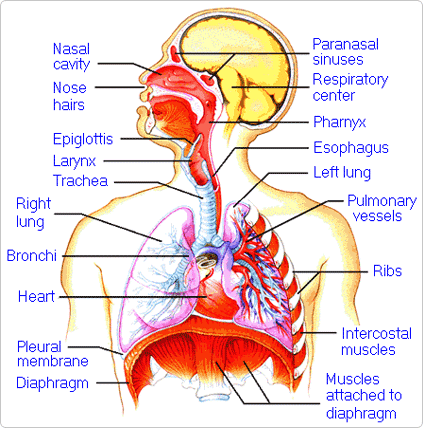
The respiratory centre , which is part of the central nervous system and part of the autonomous nervous system, sends a signal to the muscles involved with respiration such as the intercostal muscles in the rib cage and the diaphragm to work faster if the levels of carbon dioxide have increased. These signals occur very quickly. During the intense activity level the abdominal muscles were also activated by the respiratory system. This was not part of the procedures so in the next repetition of the experiment this should be included in the procedures as one of the variables to observe.


As the muscles around the lungs contract,they enlarge the area around the lungs.The enlarged area around the lungs decreases the pressure in the lungs. The pressure outside the body is greater at that point than in the lungs so air from the outside is forced into the lungs by the difference in pressure. As the muscles
relax and return to their original positions, the higher pressure on the lungs forces air from the lungs into the air.

The lungs are comprised of two main sections. The left and the right lungs. Air from the outside enters through the nose and the mouth and heads down the trachea, to the bronchial tubes and into each lung. While the air is inhaled, the rib cage expands and the diaphragm contracts. While exhalation is taking place, the rib cage gets smaller as the rib muscles relax and the diaphragm relaxes as well.


During a work-out, the muscles being used need more oxygen. This causes to breathing faster. After finishing the task, the muscles need to relax in order for them to resupply with oxygen. The level of oxygen in the body comes back to its normal amount after about 36 to 48 hours of rest after a full body exercise. The time varies also depending on the age, the gender, the size and how the activity was demanding or not. If you eat a lot of protein and you massage your muscles, it will help them heal faster. To avoid cramps and stiffing, it is good to include stretching before and after the exercise. Drinking plenty of water and hydrating your body will help as well.

This experiment could also test the level of carbon dioxide produced at the different levels of activity. This can be measured by having the subjects blow through a straw into lime water. Lime water turns murky white in the presence of carbon dioxide. The faster the lime water turned milky white, the more carbon dioxide the subject must be exhaling.
.
.

Friday, May 1, 2009

Conclusion

The results in the experiment indicated that both respiration and pulse increased with higher activity levels. The range in the results could be explained by different levels of strenuous activities, some requiring more oxygen, and by different levels of fitness among the subjects. The mean results support the hypothesis. The body systems did react to the increase of action because the more the activity was demanding, the more the body metabolic mechanism evaluated had a severe and higher result. The hypothesis was also supported because while doing the experiment we noticed that the results changed immediately when the level of exercise attempt was more demanding than the previous actions. The body reacted very quickly. The data observed in the charts were an average for a healthy teenager and it helped to understand how each system works together to make our body adjust to various types of fitness.
.
.